Hydro-Québec Is Running Short of Power: Why Solar Is Now for Quebec Businesses
On November 3, 2026, Hydro-Québec filed its 2027-2041 Supply Plan with the Régie de l'énergie. The message is clear: Quebec no longer has surplus electricity, and it will run short starting in 2029.
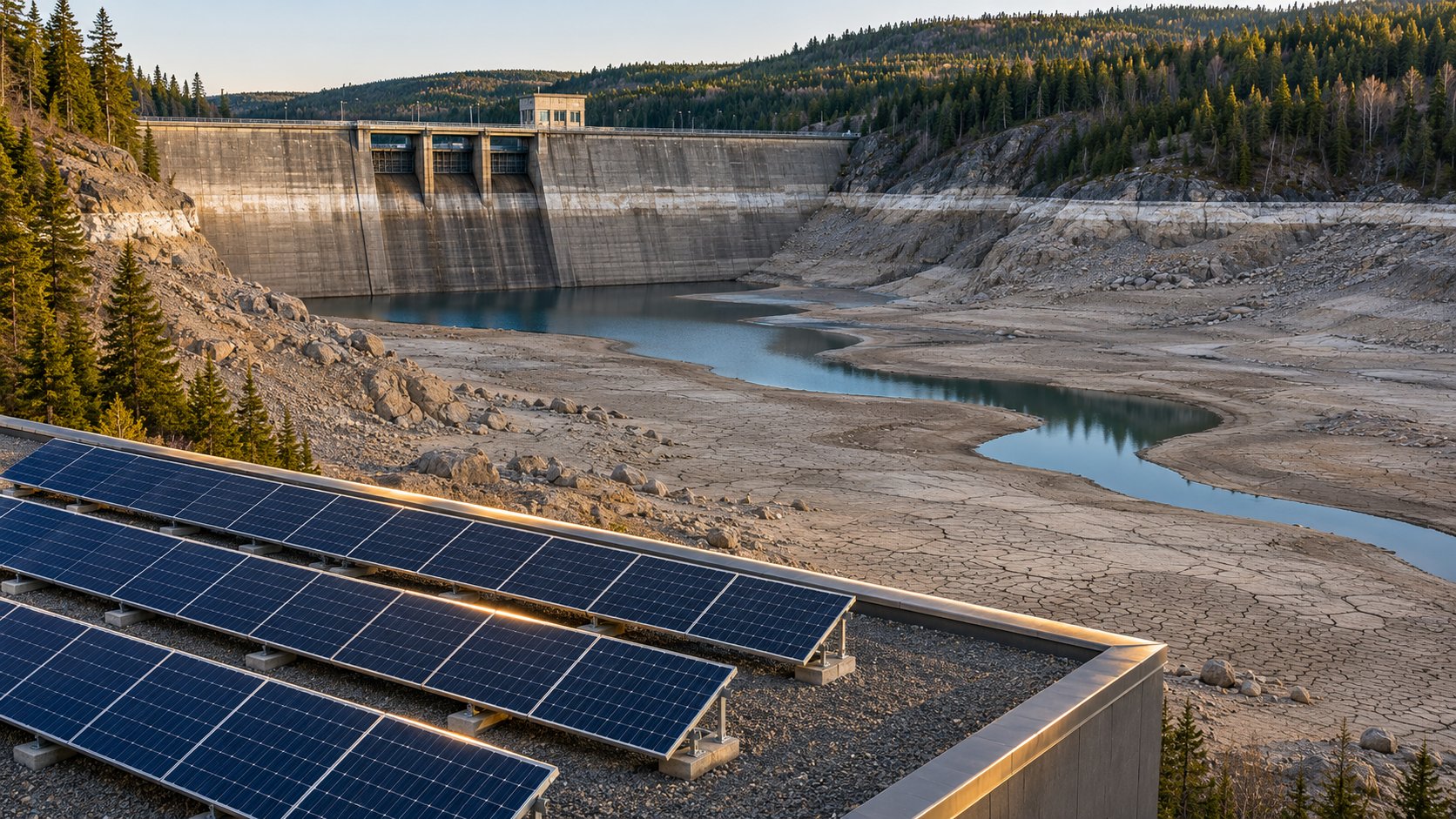
For decades, Quebec businesses relied on abundant, clean power that was among the cheapest in North America. That model is changing before our eyes. Low reservoirs, record imports and announced rate increases all point in the same direction.
For a manufacturer, a retailer or a farm, the question is no longer whether solar belongs in Quebec. The question is how much waiting will cost.
Key takeaways
- Hydro-Québec expects an electricity deficit from 2029 and will import power for most of the 2027-2041 period.
- 2026 is its fourth consecutive year of low water inflows; its reserves are at their lowest since 2014.
- Rates are set until 2028. After that, Hydro-Québec has announced increases, especially for the largest consumers.
- Hydro-Québec itself is betting on solar and storage, and offers financial assistance to businesses that generate their own power.
- A commercial solar project takes 12 to 24 months. To produce before 2029, 2026-2027 is the time to start.
What Hydro-Québec's plan reveals
Demand is growing faster than generating capacity. According to the plan, electricity sales in Quebec will rise from 182 TWh in 2026 to 240 TWh in 2041. That is 58 TWh more, roughly the annual consumption of 3 million households.
Winter peak demand will climb by 12,000 MW to reach 52,000 MW. For reference, a record peak of just over 43,000 MW in February 2023 already put the grid under severe strain.
Where will this demand come from? Mostly from businesses:
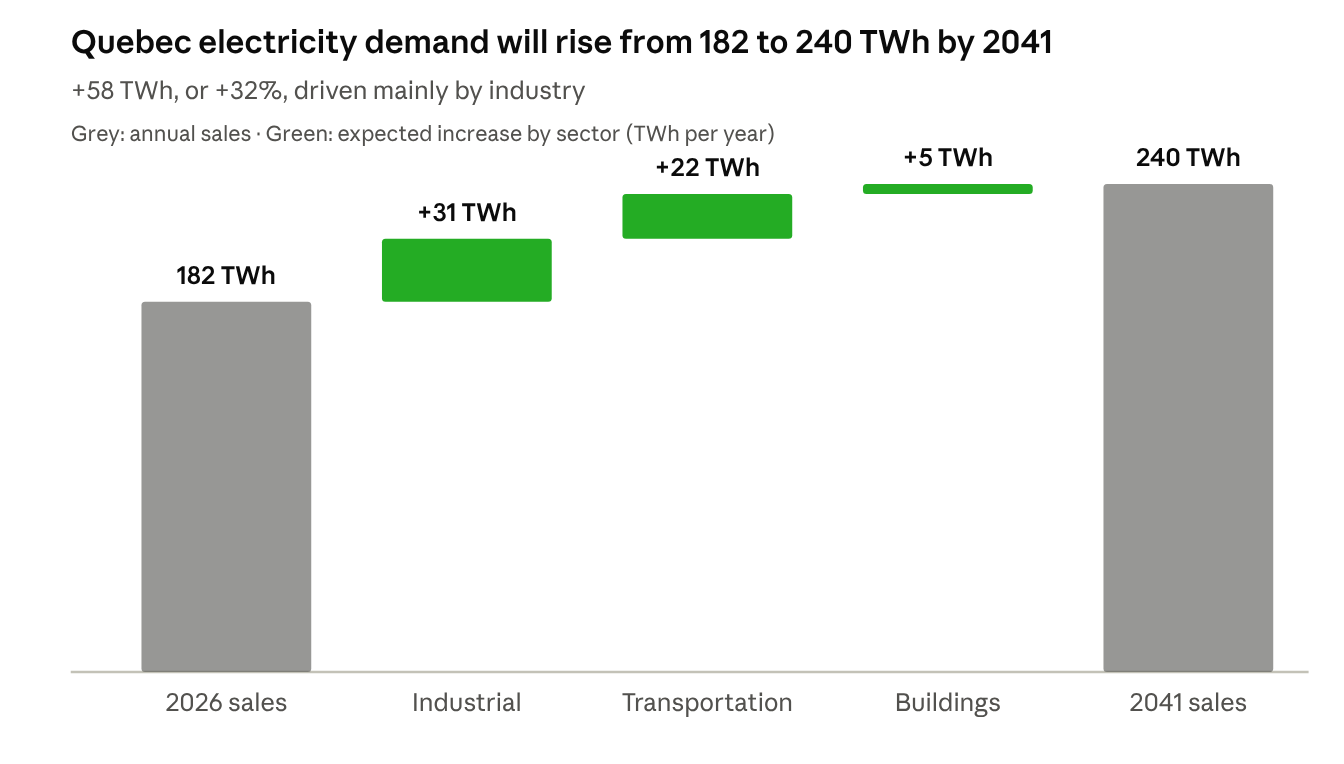
Source: Hydro-Québec, 2027-2041 Supply Plan (Le Devoir, Radio-Canada, Le Journal de Montréal, November 3, 2026)
Reservoirs at their lowest since 2014
Drought has persisted in the James Bay region since 2023. Hydro-Québec confirms that 2026 is its fourth consecutive low-water year, and it expects another weak year in 2027.
The direct result: in 2025, for the first time in its history, Hydro-Québec became a net importer of electricity, buying more than 15 TWh from neighbouring markets. That record is expected to be broken in 2026.
Importing, even when the water returns
The most striking point in the plan: even with reservoirs back to normal, Hydro-Québec expects to import up to 5 TWh a year through the 2030s. The tightest period runs from 2031 to 2040, until new generating stations and wind farms come online.
On top of that, significant new supply will be needed from 2029, as several wind contracts signed 20 years ago expire. Part of the imported electricity comes from gas-fired plants in neighbouring markets.
Electricity rates will rise after 2028
Rates are set by the Régie de l'énergie until 2028. After that, Hydro-Québec will return to the Régie to request increases, and it makes no secret of it. Its vice-president of energy strategy, Dave Rhéaume, told La Presse that a rate increase is certain given the size of the investments.
The reason is simple arithmetic. Hydro-Québec plans to invest $200 billion to increase production, the equivalent of a second James Bay project. That figure could climb further if financing costs keep rising.
Some experts go further. Analyst Jean-Pierre Finet, of the Regroupement des organismes environnementaux en énergie, believes increases could reach 5 to 10% per year, well above the 3% cap of recent years.
Businesses on the front line
Hydro-Québec's strategy to limit residential increases is to charge more to the largest consumers and to data centres. In other words, if someone pays less, someone else pays more.
Hydro-Québec also wants stronger price signals to shift consumption away from peak hours. For a business, this means that when it consumes, not just how much, will weigh more and more on the bill.
Hydro-Québec itself is betting on solar
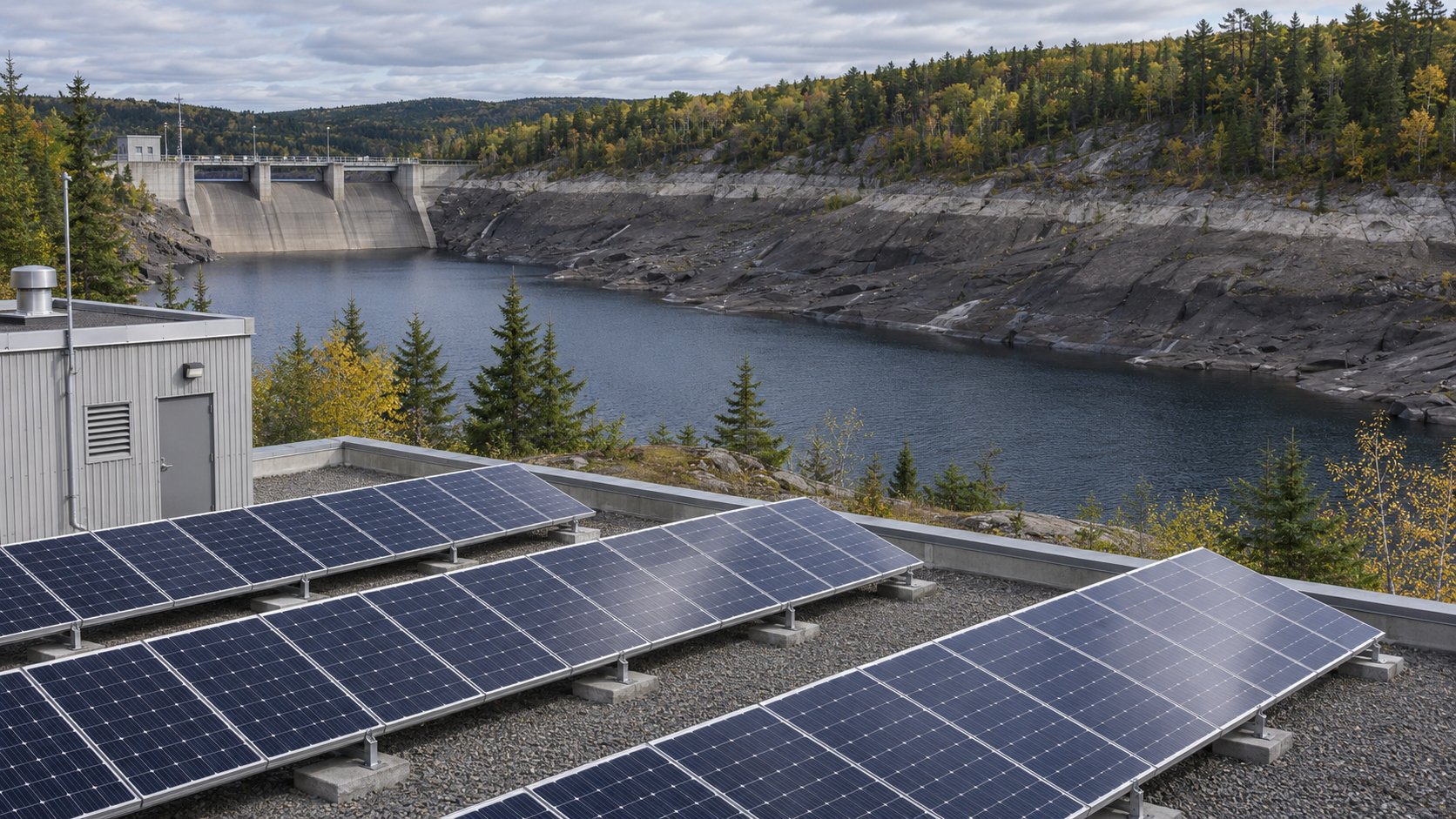
Long overlooked in Quebec, solar is now part of Hydro-Québec's official strategy. Its plan calls for about 2,750 MW of solar by 2041, not counting customer self-generation, plus 500 MW of battery storage by 2035.
The message is clear: every kilowatt-hour produced on a business's roof is one the grid does not have to generate, transmit or import. Hydro-Québec is also targeting 21 TWh of energy savings and a 3,500 MW reduction in peak demand by 2035, counting on its customers.
Financial assistance for businesses
Since 2026, Hydro-Québec has offered financial assistance for solar self-generation. For residential customers, it reaches $1,000 per installed kW, up to 40% of eligible costs.
Commercial, industrial and agricultural businesses apply through Hydro-Québec's Efficient Solutions program. Amounts and conditions vary by project, so eligibility must be confirmed before ordering equipment, a step we handle for our clients.
Industrial: protect costs and production
The industrial sector accounts for the largest share of expected demand growth, with 31 TWh more by 2041. It will also be the most exposed to increases targeting large consumers.
- Large roofs and land areas, ideal for systems of several hundred kilowatts.
- Daytime, weekday consumption that matches solar production hours.
- A more stressed grid means more risk of voltage sags and outages. Solar combined with storage helps protect sensitive equipment.
- Decarbonization and ESG reporting goals increasingly required by customers.
Commercial: cut the bill and the peak
Shopping centres, warehouses, office buildings and retail stores often have large, unused flat roofs. Those roofs can become an asset by directly reducing electricity purchases.
- Maximum production in summer, when air conditioning drives consumption up.
- Paired with a battery, solar reduces demand charges, which weigh heavily on commercial bills.
- A concrete, visible brand statement for customers and tenants.
Agricultural: the farm as an energy producer
Dairy farms, poultry barns, hog barns and greenhouses use a lot of electricity: ventilation, milk cooling, lighting, pumping. Greenhouses are among the emerging sectors identified by Hydro-Québec.
- Large farm-building roofs, often well oriented and unshaded.
- Year-round, continuous consumption that makes every kilowatt-hour count.
- More resilience during outages, critical for ventilation and livestock.
- Farm operations are eligible for Hydro-Québec financial assistance.
The time factor: act in 2026-2027
A commercial or industrial solar project does not happen in a few weeks. Feasibility study, design, Hydro-Québec interconnection request, financial assistance application, procurement and installation generally take 12 to 24 months.
The timeline is tight. Rates are set until 2028, and the power deficit begins in 2029. Businesses that start their study now will be producing their own electricity before prices rise. Those who wait risk taking the full hit.
Solar in Quebec: what to know before you start
A good solar project rests on an honest analysis. Here is what we explain to every client.
- Winter produces less. November, December and January are the weakest months. Production is concentrated from spring to fall, and the annual balance remains very attractive.
- The winter peak is managed with storage. Solar reduces the energy you buy. A battery reduces demand peaks when electricity costs the most.
- Roof first. Panels go on for 25 years or more. A roof near the end of its life must be replaced first, or everything will have to be removed later. That is why we always assess the roof and the solar system together.
- Interconnection must be planned. Hydro-Québec must approve the project before installation. A well-prepared application avoids months of delay.
This is exactly where integrated roofing and solar expertise makes the difference.
What makes a solar project profitable?
There is no single number: profitability is decided site by site. These are the six factors we analyze first.
- Consumption profile: a business that uses power during the day, on weekdays, consumes its solar production directly.
- Electricity rate and demand charges: the more peak-related charges on the bill, the more attractive storage becomes.
- The roof: available area, orientation, shading, load capacity and remaining service life.
- Eligible financial assistance: it directly reduces the upfront investment, provided it is confirmed before purchase.
- Interconnection conditions: Hydro-Québec's size limits and requirements shape the design.
- Rate trends: every increase after 2028 improves the return of a system already in place.
That is why every decision should start with an independent feasibility study.
AL Pro Solutions: your independent solar advisor
AL Pro Solutions is a Quebec consulting firm specializing in commercial roofing and solar energy. We support industrial, commercial and agricultural businesses across Greater Montreal, Laval and all of Quebec. Our approach: Solar + Roofing = Integrated Expertise.
As an independent advisor, we do not sell a panel brand. We defend your interests, from the first calculation to commissioning.
Our process has three simple phases:
- Feasibility: analysis of your consumption, roof and solar potential, with a profitability estimate and the financial assistance you qualify for.
- Design: system sizing, storage where relevant, drawings, tendering and the Hydro-Québec interconnection request.
- Installation: site supervision, quality control, commissioning and performance follow-up.
Why install solar panels for a business in Quebec in 2026?
Because Hydro-Québec expects an electricity deficit from 2029 and rate increases after 2028, especially for the largest consumers. A project started now will be producing before those increases.
Is solar profitable in Quebec despite cheap electricity?
Increasingly so. Rates are going up, Hydro-Québec financial assistance lowers the upfront cost, and panels produce for 25 years or more. Profitability depends on each site, which is why a feasibility study matters.
Is there a grant for commercial, industrial or agricultural solar?
Yes. Businesses apply through Hydro-Québec's Efficient Solutions program. Amounts and conditions vary by project, and eligibility must be confirmed before buying equipment.
Do solar panels produce in winter in Quebec?
Yes, but less. Production is concentrated from spring to fall. For winter peaks, battery storage is the right complement.
How long does a commercial solar project take?
Generally 12 to 24 months, from feasibility study to commissioning, depending on project size and interconnection timelines.
Should the roof be replaced before installing solar panels?
If the roof has less than 25 years of remaining life, it is often better to replace it first. AL Pro Solutions assesses the roof and the solar system together to avoid costly removal later.
The time is now
The window is open, but it will not stay open long. Businesses that act in 2026-2027 lock in their energy costs before 2029. The others will pay the price of waiting.
Let's talk about your project. Contact AL Pro Solutions for an initial assessment of your solar potential.
📧 al@alprosolutions.ca · 📞 514 222-0998 · 🌐 alprosolutions.ca
About the author
Aurelien Leblay is the founder of AL Pro Solutions, a Quebec consulting firm specializing in commercial roofing and solar energy. An Elevate-certified applicator and independent solar advisor, he supports industrial, commercial and agricultural businesses across Greater Montreal, Laval and all of Quebec, from feasibility study to commissioning. His conviction: solar and roofing must be planned together.
Sources
- Sylvain Larocque, Les niveaux d'eau d'Hydro-Québec sont à leur plus bas depuis 2014, Le Journal de Montréal, November 3, 2026
- Hélène Baril, Hydro-Québec manque de jus, La Presse, November 3, 2026
- Véronique Morin, Hydro-Québec : « Attendez-vous à payer beaucoup plus cher », prévient un analyste, TVA Nouvelles, November 3, 2026
- Charles-Antoine Boulanger, Hydro-Québec est en quête d'électricité pour éviter une pénurie dès 2029, Radio-Canada, November 3, 2026
- Le Devoir, overview of Hydro-Québec's 2027-2041 Supply Plan, November 3, 2026
- 98.5 FM, La commission, interview with Yvan Cliche (CÉRIUM), November 3, 2026
- Hydro-Québec, Efficient Solutions program
Ready to take action?
Discuss your project with our experts.