Hydro-Québec's Drought: Why Rooftop Solar Is Now Your Insurance Policy
Key takeaway: after three straight years of low water in its reservoirs, Hydro-Québec now imports more electricity than it exports. Rising power prices are not only about demand: supply is shrinking too. For a business, a 250 kW solar system costs about $280,000 net after Hydro-Québec and federal incentives, and pays back in roughly 6.6 years.
Hydro-Québec Is Living Its Own Strait of Hormuz Crisis
Hydro-Québec's fuel is the water in its reservoirs, and it is running short. Its largest reservoir, Caniapiscau, was three-quarters empty, and reservoir levels remain at a low point.
The result: Quebec, historically a net exporter, now imports more electricity than it exports. Exports are Hydro-Québec's most profitable sales, so the shortfall hits its earnings and, in turn, Quebec government revenue.
To see how far things have shifted, here is who bought Hydro-Québec's electricity in 2022, a year when 16.5% of sales left the province.
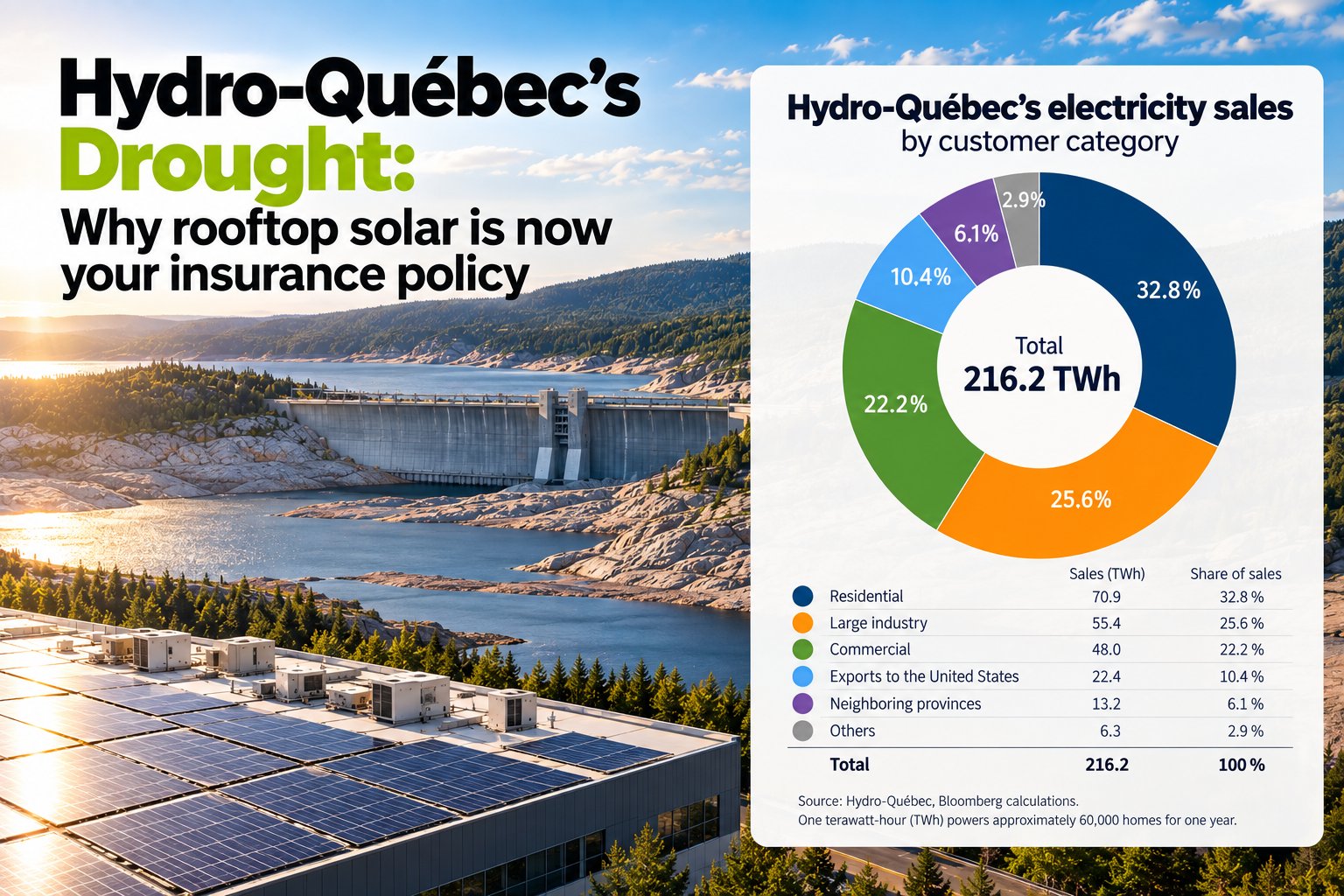
| Customer category | 2022 sales (TWh) | Share of sales |
|---|---|---|
| Residential | 70.9 | 32.8% |
| Large industrial | 55.4 | 25.6% |
| Commercial | 48.0 | 22.2% |
| U.S. exports | 22.4 | 10.4% |
| Neighbouring provinces | 13.2 | 6.1% |
| Other | 6.3 | 2.9% |
| Total | 216.2 | 100% |
Source: Hydro-Québec, Bloomberg calculations. One terawatt-hour powers about 60,000 homes for a year.
The Myth: Prices Are Rising Only Because of Demand
Rising power prices are usually blamed on data centres, electric vehicles and industrial electrification. That is true, but it is only half the story.
The other half is supply, which drops when reservoirs run low. Less water means less generation, fewer profitable exports and more purchases from outside Quebec.
Quebec's Plan: $87 Billion to Go From 41% to 60% Electricity
On June 30, 2026, Quebec released its first Integrated Energy Resource Management Plan (PGIRE) 2026-2050. It calls for about $87 billion over 25 years to raise electricity from 41% to roughly 60% of the province's energy mix by 2050.
The catch: today's system already struggles to get through a single drought year. One thing depends on neither the rain nor the government's plan: your own solar generation, on your plant's roof.
The Business Case for Commercial Solar in Quebec
Two incentives can be stacked today:
- Hydro-Québec pays $1,000 per installed kW, up to 40% of eligible costs, for panels purchased after March 31, 2026. The net metering limit has also risen from 50 kW to 1 MW.
- The federal Clean Technology Investment Tax Credit covers 30% of the remaining balance for eligible corporations.
Example for a standard commercial project at AL Pro Solutions:
| Step | Amount |
|---|---|
| Gross cost of a 250 kW system | $650,000 |
| Hydro-Québec incentive ($1,000/kW, under the 40% cap) | − $250,000 |
| Federal tax credit (30% of the $400,000 balance) | − $120,000 |
| Net cost | $280,000 |
| Estimated annual savings | $42,500 |
| Payback | ≈ 6.6 years |
Savings are prorated from a comparable 500 kW warehouse that saves $85,000 a year. After payback come nearly 20 years of electricity that neither the rain, nor the Régie de l'énergie, nor the next government can take away.
Indicative estimate: actual results depend on your bill, rate, roof and tax eligibility. Confirm the tax credit with your accountant.
Roofers First, Solar Second
At AL Pro Solutions, we assess the roof first, then price the project against your actual bill. As an Elevate-certified applicator, we make sure the membrane will last as long as the panels: 25 years or more.
While Quebec waits for rain, how long do you want to depend on a grid that itself depends on the weather?
Why Is Hydro-Québec Importing Electricity?
After several years of low water inflows, its reservoirs are short of water. It generates less and buys more from outside Quebec, to the point of importing more than it exports.
Why Are Electricity Prices Rising in Quebec?
For two reasons: demand is growing (data centres, EVs, industry) and supply drops when reservoirs run low. The PGIRE plans $87 billion in investment by 2050.
What Incentives Exist for Commercial Solar in Quebec?
Hydro-Québec pays $1,000/kW, up to 40% of the project. The federal Clean Technology ITC covers 30% of the balance for eligible corporations.
What Is the Payback on a Commercial Solar System?
For a 250 kW system, about 6.6 years: $280,000 net for roughly $42,500 in annual savings, followed by nearly 20 years of near-free electricity.
Request Your Solar Feasibility Study
Do you own a plant, warehouse or commercial building in Quebec? Contact us to assess the roof and price the project against your actual bill.
📧 al@alprosolutions.ca · 📞 514 222-0998 · 🌐 alprosolutions.ca
Ready to take action?
Discuss your project with our experts.