Solaire · May 19, 2026
Solar Financing and Grants Available in 2026 in Quebec: The Complete Guide for Businesses
Hydro-Québec OSE 6.0, the 30% federal Clean Technology Investment Tax Credit, and accelerated depreciation: the complete guide to commercial solar incentives in Quebec for 2026, with worked examples and concrete next steps.
If you manage a commercial, industrial, or institutional building in Quebec, 2026 marks a major turning point: for the first time, the financial conditions make a solar project genuinely profitable in the short term. Between Hydro-Québec's new incentives, the 30% federal tax credit, and accelerated depreciation, it is now possible to reduce the net cost of a solar project by more than 70% — before even accounting for the savings on your electricity bill.
Yet the vast majority of commercial property owners and building managers are still unaware of these programs. This guide was written to give you a clear, number-backed, and up-to-date picture of everything available — and how to make the most of it.
 2026 Quebec commercial solar grants — the complete guide for businesses
Why 2026 is the pivotal year for commercial solar in Quebec
For years, solar energy in Quebec was seen as financially unattractive. The reason was straightforward: with electricity rates among the lowest in North America, the return on investment often stretched to 25–30 years. That simply wasn't viable for a business.
Three major changes transformed that reality in 2026:
- Hydro-Québec's subsidy program is now active (since March 31, 2026).
- The 30% federal tax credit applies to all commercial solar equipment.
- The maximum self-production capacity has increased from 50 kW to 1 MW, opening the door to large-scale projects.
These three elements combined bring the return on investment down from 25–30 years to approximately 5 to 10 years, depending on the size and configuration of your installation.
Incentive #1 — Hydro-Québec's Solutions efficaces program (OSE 6.0)
The Solutions efficaces program (OSE 6.0 component) is Hydro-Québec's primary subsidy program for business customers. It provides a direct grant of $1,000 per kilowatt (kW) installed, covering up to 40% of the total project cost (equipment and labour included).
Key numbers for the program:
- Amount: $1,000 per kW installed
- Cap: 40% of total eligible cost
- Average grant for a business: approximately $45,000
- Maximum capacity: up to 1 MW per account
- Eligibility date: projects installed since March 31, 2026
- Application deadline: maximum 9 months after installation
Applications are submitted through the OSE tool of Hydro-Québec's Solutions efficaces program. Important: the grid connection request with Hydro-Québec must be approved before work begins — failure to do so may result in losing eligibility for the subsidy.
What is covered: solar panels, mounting structure, wiring, and labour. Battery storage, taxes, and portable infrastructure costs are not included.
Incentive #2 — Federal Clean Technology Investment Tax Credit (CT ITC)
The federal government offers a refundable 30% tax credit on the capital cost of eligible commercial solar equipment. This credit is applied directly against your corporation's federal income tax owing, and if it exceeds your tax liability, the excess is paid back to you in cash.
Key numbers for the credit:
- Credit rate: 30% of eligible capital cost
- Type: refundable (cash refund if credit exceeds tax owing)
- Eligibility period: equipment acquired between March 28, 2023 and December 31, 2033
- Who qualifies: any taxable Canadian corporation
- Stackable: yes, with provincial incentives
On a $250,000 project, the 30% federal credit represents $75,000 recovered directly. This is not a tax deduction — it is a real cash reimbursement. This credit is fully stackable with the Hydro-Québec program, which is a significant advantage.
Incentive #3 — Accelerated depreciation (CCA Classes 43.1 and 43.2)
In addition to the tax credit, businesses can claim 100% depreciation in the first year on eligible solar equipment (Classes 43.1 and 43.2 of the Income Tax Act). This creates an immediate and substantial tax shield, particularly valuable for profitable businesses looking to reduce their tax burden in the year of the project.
For a business with an effective tax rate of 20%, writing off $250,000 in equipment in a single year generates a tax saving of approximately $50,000 in the current fiscal year — on top of the 30% federal credit.
Net metering: turning your roof into a revenue-generating asset
Alongside the grants, Hydro-Québec offers net metering: electricity your panels produce but do not consume is fed back into the grid, and you accumulate kilowatt-hour credits that can be used during periods of lower production (nights, cloudy winter days).
With the new 1 MW cap per account, large-scale commercial and industrial installations can now take full advantage of this mechanism.
Summary table: combining the incentives
A concrete example: a factory or warehouse installing a 250 kW solar system at an estimated gross cost of $350,000.
- Hydro-Québec subsidy (40%): $140,000
- Federal CT ITC (30% on the balance): $63,000
- Savings via accelerated depreciation (year one): approximately $21,000
- Estimated net cost: approximately $126,000
- Total reduction on initial cost: approximately 64%
These figures are indicative. The exact amounts depend on your installation's configuration, your tax profile, and the eligibility conditions specific to each program. A personalized analysis is recommended.
Eligibility requirements
To qualify for the Hydro-Québec program, your project must:
- Be installed by a certified contractor recognized by Hydro-Québec
- Use equipment certified for the Canadian market
- Have obtained Hydro-Québec's grid connection approval before work begins
- Be located in a commercial, industrial, or institutional building in Quebec
One often-overlooked factor: the condition of your roof. Before approving a grid connection and moving forward with installation, the supporting structure must be able to bear the weight of the panels for 25 to 30 years. A roof nearing the end of its service life can jeopardize the entire project — and generate major unforeseen costs. That is why a preliminary roof inspection is part of our turnkey process at AL Pro Solutions.
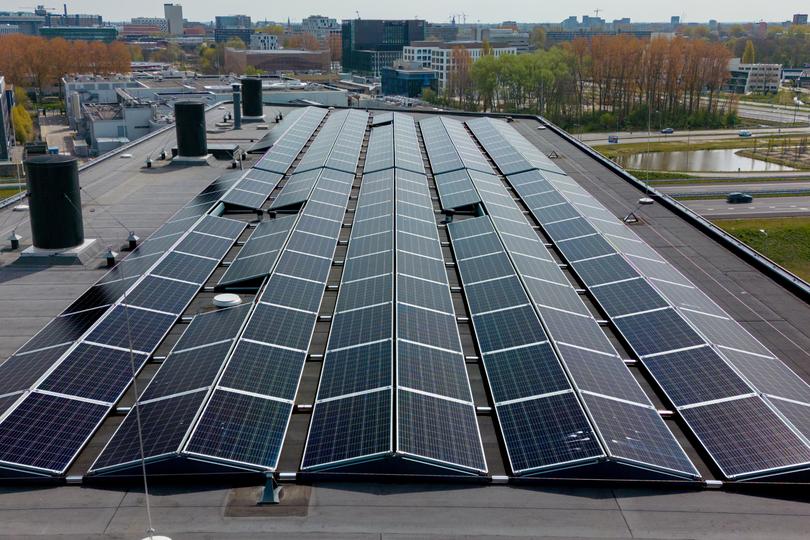 Drone roof inspection before solar installation
Where to start
Here are the concrete steps to launch a commercial solar project in 2026:
- Assess your roof's potential: available surface area, orientation, shading, structural condition.
- Calculate your annual consumption: the foundation for correctly sizing your installation.
- Obtain a personalized profitability analysis incorporating all three incentives and your consumption profile.
- Submit the grid connection request to Hydro-Québec before any work begins.
- Engage a certified contractor for the installation.
- File the OSE subsidy application within 9 months of installation completion.
Conclusion
In 2026, failing to evaluate a solar project for your commercial building means leaving tens of thousands of dollars on the table. The window for the 30% federal tax credit closes in 2033. Hydro-Québec program budgets are not unlimited. The earlier you begin the evaluation, the better positioned you are to plan and maximize your incentives.
At AL Pro Solutions, we offer a complete solar feasibility analysis for your building: roof assessment, yield calculation, ROI simulation with integrated incentives, and turnkey support through to commissioning.
Contact us for a free analysis: alprosolutions.ca · 514 222-0998 · al@alprosolutions.ca
This article is updated regularly to reflect program changes. Last updated: May 2026. Amounts and conditions may change — always verify with official Hydro-Québec and Canada Revenue Agency sources for the most current information.
← Retour au blogue
Contact AL Pro Solutions : +1 514 222-0998 · al@alprosolutions.ca