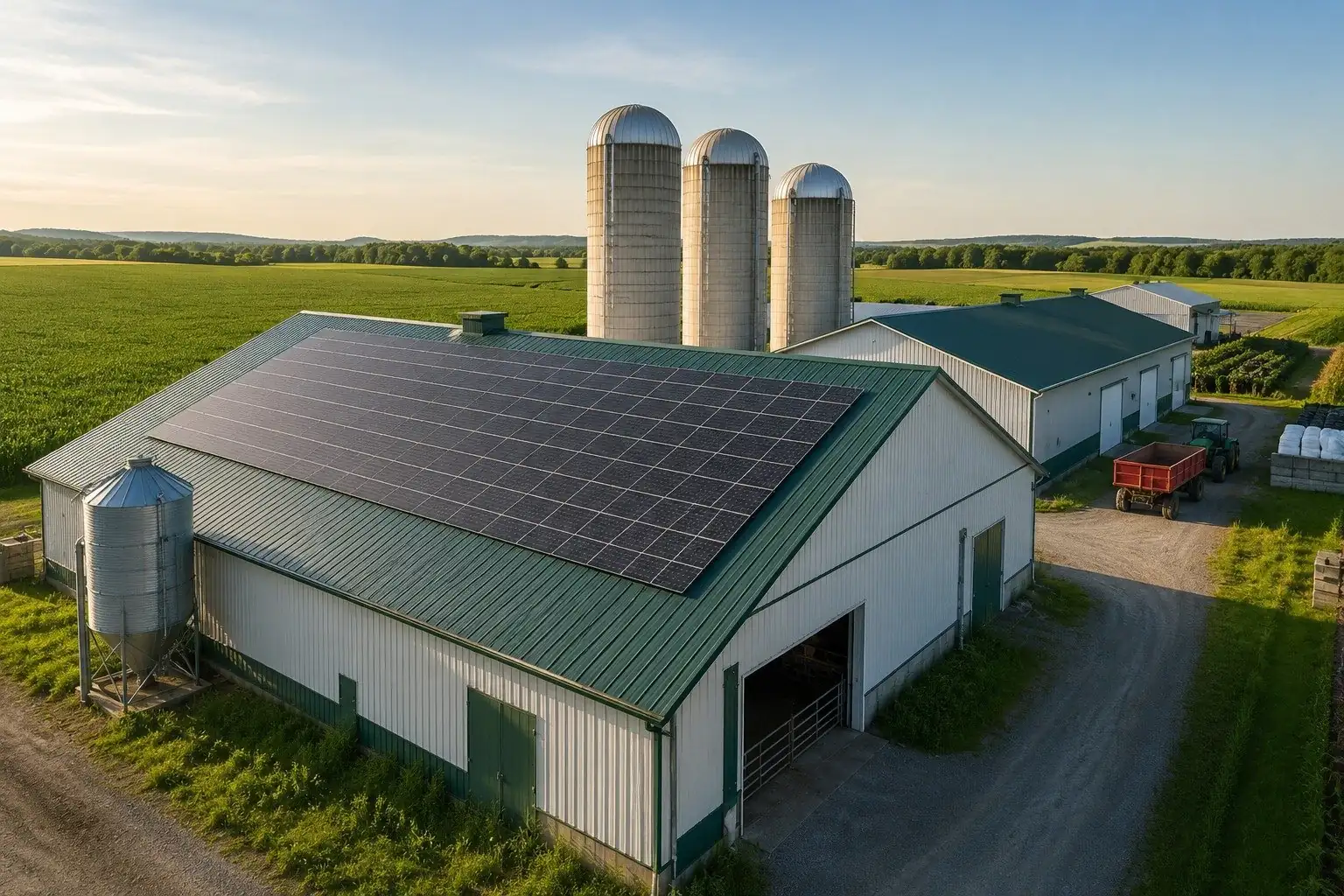
Why agricultural solar suits Quebec farms
Farms often have large, well-exposed roofs and open ground. Their electricity use is high and steady: ventilation, milk cooling, lighting, heating, pumping.
That is exactly the profile that makes the best use of solar energy produced on site.
Dairy farms, poultry barns, hog barns: high energy needs
A well-sized solar system directly reduces these operating costs.
- Dairy farms: milk cooling, milking robots, vacuum pumps and water heaters run every day
- Poultry barns: ventilation, lighting and heating make up a large share of costs
- Hog barns: ventilation and temperature control require constant power
Our three phases: feasibility, design, installation
1. Feasibility. Analysis of your bills, your buildings and your interconnection, with an estimate of production and savings.
2. Design. Choice of location (roof or ground), system sizing, drawings and the Hydro-Québec process.
3. Installation. Site supervision and commissioning, planned around your operations so production is not disrupted.
Mounted on a farm building roof or on the ground
Depending on your buildings and your land, panels can go on the roof of the barn, the poultry house or the storage building, or on the ground. Thanks to our roofing expertise, we check the condition and capacity of your roofs before recommending the best option.
Hydro-Québec programs for farm producers
We identify the programs and support available to your operation and build them into the profitability calculation.
Regions served
We serve farm producers in Montérégie, Estrie, Centre-du-Québec, Lanaudière, the Laurentians, Chaudière-Appalaches, Bas-Saint-Laurent and throughout Quebec.
Frequently asked questions about agricultural solar
Is solar profitable for a dairy farm?
Often yes, thanks to high and steady consumption. Our feasibility study confirms it for your farm.
Can panels be installed on a barn or a poultry house?
Yes, if the structure and the roof allow it. We check both before design.
Is it better to mount on the ground or on the roof?
It depends on your buildings, your land and the available sunlight. We compare both options for you.
Do the panels harm the animals?
No. On a roof they have no impact on the animals, and the installation is planned so your operations are not disturbed.
What programs exist for farm producers?
We identify the programs in force during the feasibility study.
How long does the installation take?
Generally a few weeks of work on site, depending on the size of the project. We provide a precise schedule.
Request your feasibility study
Let's talk about your farm buildings and their solar potential.